

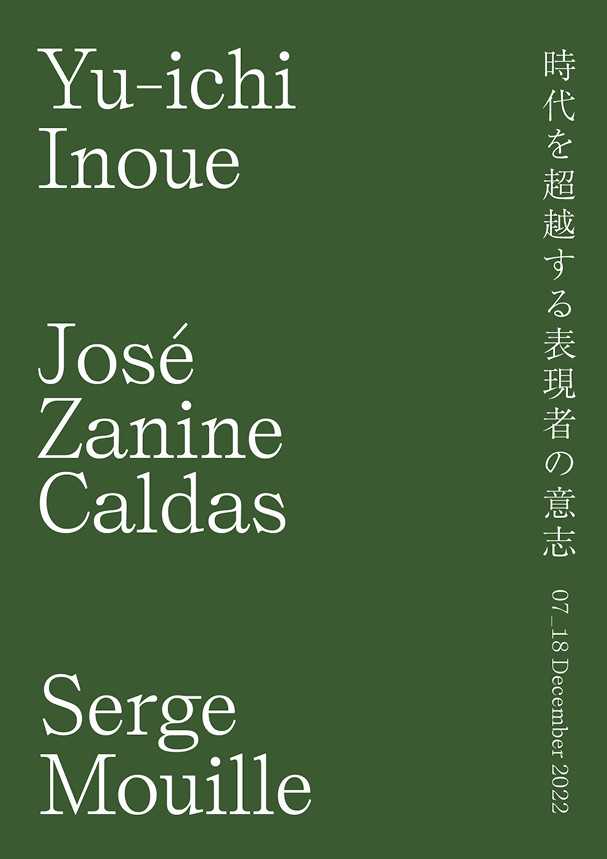
From Wednesday, December 7 to Sunday, December 18, 2022, BUNDLE-GALLERY held a special exhibition titled "The Will of Timeless Creators – Yu-ichi Inoue, José Zanine Caldas, Serge Mouille –", showcasing the calligraphy of Yu-ichi Inoue, the furniture of José Zanine Caldas, and the lighting of Serge Mouille.
Although the three worked in different countries and fields, they shared a commonality in continuously evolving their expressions and embracing new challenges in response to changing times and awareness. This exhibition focused on how their sensibilities changed over the years and how they expressed those changes, introducing their work in a multifaceted way through vintage pieces and rare museum items. It was inspired by the fantasy that these contemporaries, despite being in different countries, may have crossed paths somewhere. The gallery itself is housed in a renovated private residence designed by Ren Suzuki, the last Japanese architect to study under Le Corbusier. Suzuki too was an expressive figure of the same era. This booklet presents the works of the three artists and records the exhibition in a space resonating with their spirit.
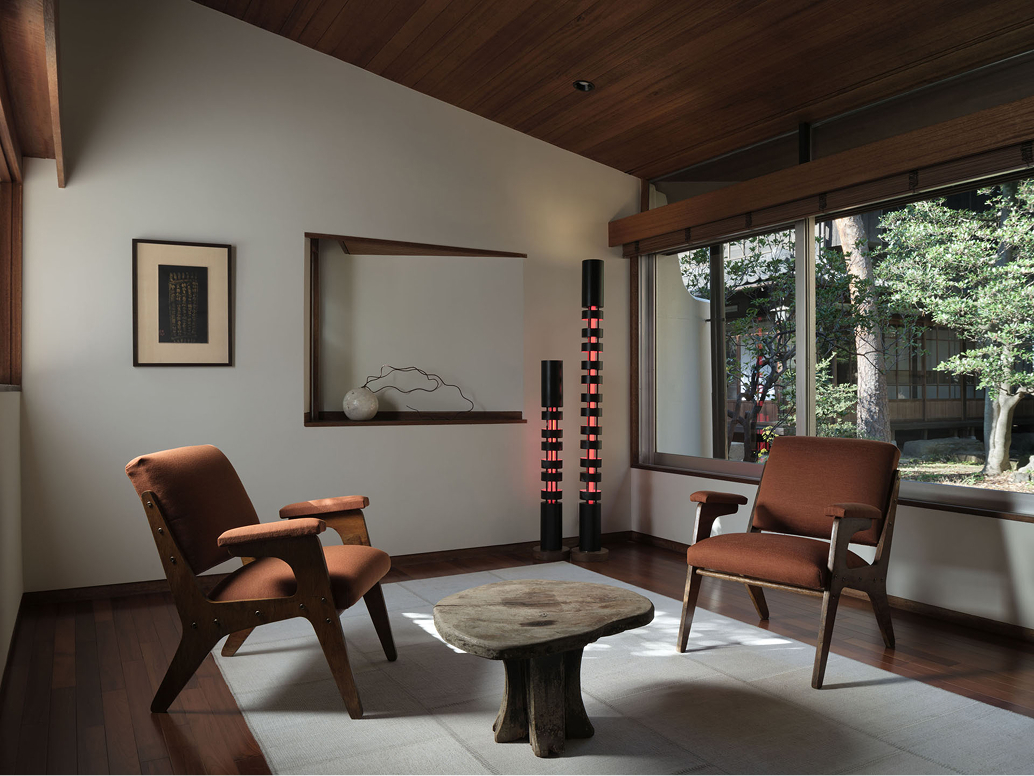
Yu-ichi Inoue
Nijibutsuzen
1963
©unac tokyo
José Zanine Caldas
H Armchairs for Móveis Artísticos Z
1950s
Low Table for Casa de Nova Vicosa
1970s(center)
Serge Mouille
Totem
1962
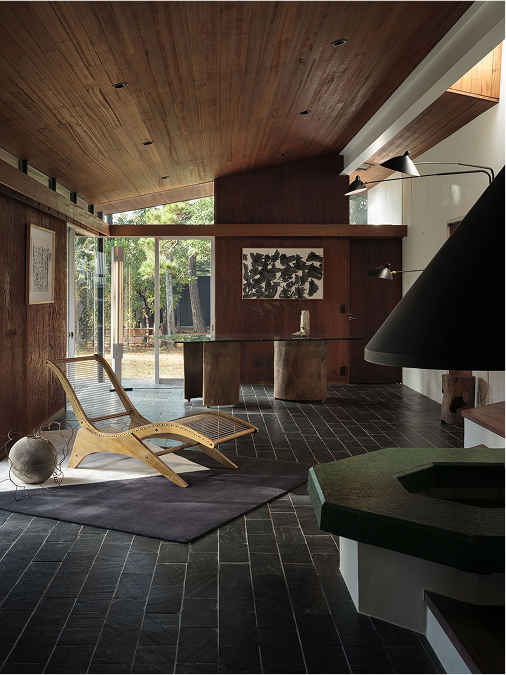
Yu-Ichi Inoue
Kubigamogemashita (right)
1981
©UNAC TOKYO
Nametokoyama no Kuma(left)
1985
©UNAC TOKYO
José Zanine Caldas
Dining Table for Museu a Casa
1970s
Chaise longue for Mòveis Artísticos Z
1950s
Serge Mouille
Signal (back left)
1962
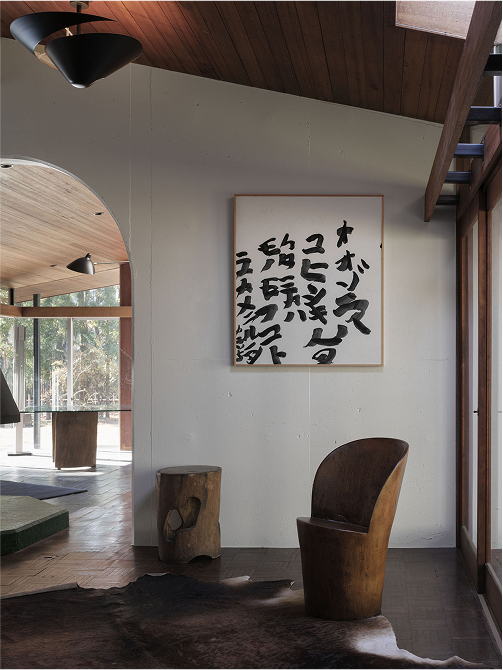
Yu-Ichi Inoue
Oozoraha
1976
©UNAC TOKYO
José Zanine Caldas
Denuncia Stool (left)
1970s
Sculpted Solid Wood Chair (right)
1970s
Serge Mouille
Small Escargot Ceiling Lamp (top left)
1955
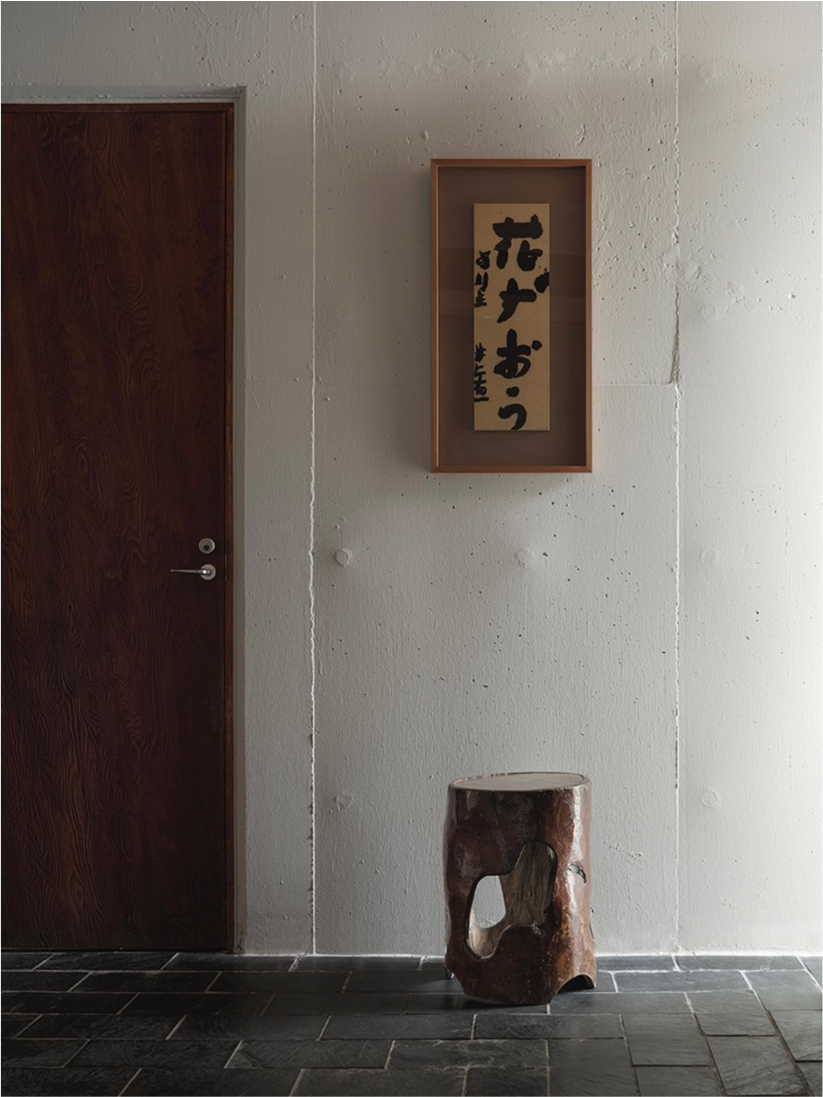
Yu-ichi Inoue
Hana-Zuo
1974
©UNAC TOKYO
José Zanine Caldas
Denuncia Stool
1970s
井上有一
Yu-ichi Inoue
1916-1985
Yu-ichi Inoue, born in Tokyo in 1916, was both a contemporary calligrapher and a teacher. He studied at Aoyama Normal School (now Tokyo Gakugei University) and worked in education for 41 years, from 1935 to 1976. Inoue once wrote, “Calligraphy is an art for all. Because anyone can become an artist through the characters they use daily, calligraphy stands as an especially superior form of art.” (The Liberation of Calligraphy – Bokubi, Issue 9, 1952). Rejecting the path of a professional artist, Inoue devoted his life to exploring new possibilities in calligraphy.
The exhibition connects Inoue, José Zanine Caldas, and Serge Mouille, starting from São Paulo in 1957. That year, Inoue was invited to participate in the São Paulo Biennale and exhibited works such as Gutetsu. His works caught the attention of British art critic Herbert Read, who featured Inoue’s pieces in his 1958 book A Concise History of Modern Painting. While engaging with new art movements such as Abstract Expressionism that began in New York in the late 1940s, Read introduced Inoue alongside Jackson Pollock, Franz Kline, and Pierre Soulages. This marked a moment when calligraphy, an Eastern visual art with roots in China, was discussed within the context of abstract art. The idea that Zanine, who was living in São Paulo at the time, may have seen Inoue’s work was the initial inspiration for this exhibition.
In 1959, Inoue exhibited at “documenta 2” at the recommendation of German curator Kasper König. In 1971, he published his first collection Flower Calligraphy Notebook and held his first solo exhibition. This exhibition aims to introduce Inoue’s multifaceted work from the 1950s, when his international recognition began to grow, to the 1980s, the final years of his life. Known for his relentless pursuit of new techniques, Inoue experimented with freezing ink, mixing it with glue, and more—demonstrating his insatiable curiosity about ink itself and about methods of expression. Writing life-sized characters on paper larger than himself with a giant brush soaked in ink, Inoue created bold forms that radiate energy and a compelling presence—even without knowing their meaning, one cannot look away. His expressive work, brimming with vitality and possessing painterly and sculptural qualities, clearly sets itself apart from traditional calligraphy.
The quote from Inoue mentioned earlier continues: “There is no other art in the world as simple, direct, yet profound, and so intimately connected to everyday life, as calligraphy.” Inoue was a rare figure who sublimated the fundamental human act of writing into art.
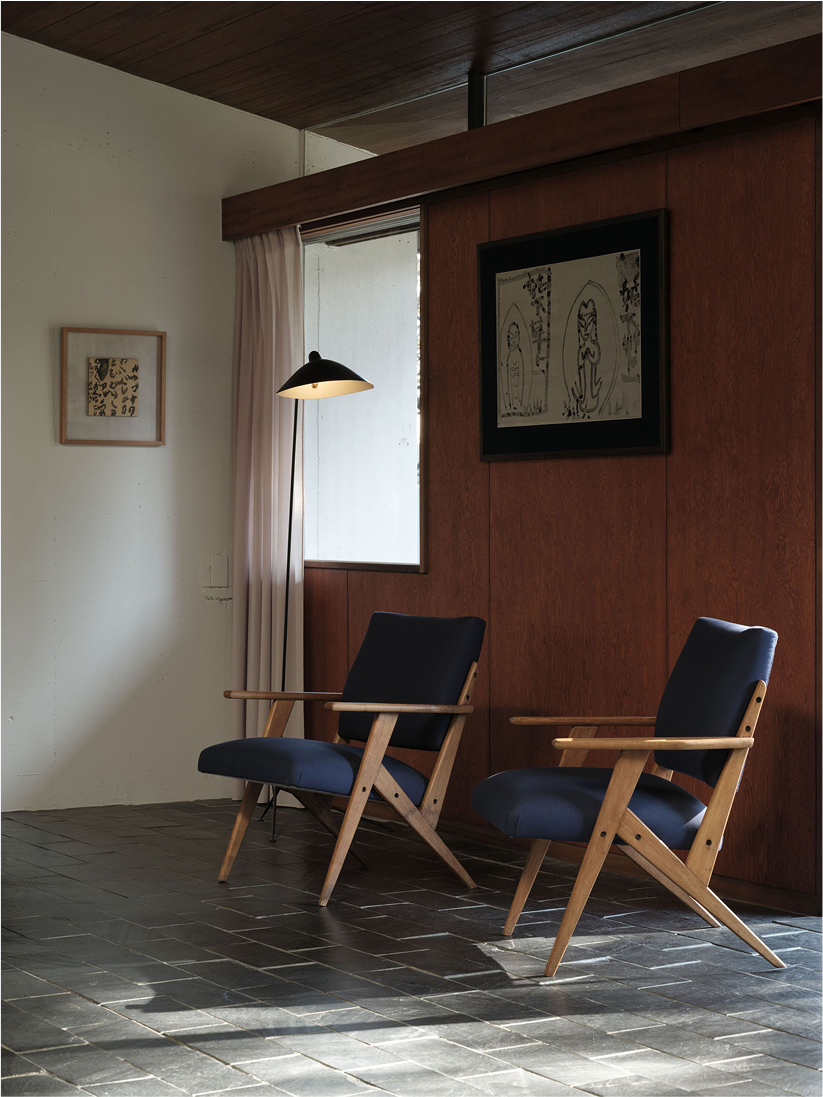
Yu-ichi Inoue
Kawadunaku
1973(left)
©UNAC TOKYO
Kaka Sojo
1965(right)
©UNAC TOKYO
José Zanine Caldas
Solid Wood Armchair for Móveis Artísticos Z
1950s
Serge Mouille
One Arm Floor Lamp
1953
José Zanine Caldas
1919-2001José Zanine Caldas was born in 1919 on the southern coast of Bahia, in northeastern Brazil. At the age of 20, he established a model-making studio and worked with Brazil’s leading architects such as Oscar Niemeyer and Lúcio Costa. He later pursued careers as an artist, designer, and architect, all through self-study.
In 1949, Zanine moved to São Paulo and established a furniture workshop, Móveis Artísticos Z, with two partners. While Charles and Ray Eames were gaining global attention for their plywood furniture in the U.S., Zanine and his partners quickly began producing similar plywood furniture in Brazil under the name Z-Artistic-Furniture. The furniture featured modern and practical designs at accessible prices, intended for city dwellers, but it was not well received at the time and ended in failure. Zanine later became a model-making instructor at the School of Architecture and Urbanism at the University of São Paulo, and then moved to the University of Brasília. However, he lost his position due to the military coup in 1964.
Returning to his hometown, Zanine became aware of the problem of deforestation along the Atlantic coast. His growing concern for forest conservation led him toward more organic design. In the 1970s, Zanine began creating Móveis Denuncia (“Protest Furniture”) using reclaimed wood from burned forests. Materials included logs of pequi, acajou sapelli, and vinhático. Pequi, whose fruit is used in regional cuisine and liqueurs, is a key species in Brazilian food culture. His sculptural, organic furniture, carved directly from massive logs, was inspired by local craftsmen who carved canoes and rowboats from felled trees. This rustic approach evolved into a style completely different from his earlier plywood designs. His philosophy also extended into architecture.
These experimental pieces, primitive in form yet environmentally conscious, reflect a close relationship with nature. Zanine, who also wrote about forests, advocated for actively using already felled wood and planting a new tree for each one cut down. In 2019, marking the centenary of his birth, furniture originally made by Móveis Artísticos Z was reissued by his descendants. The reissued pieces followed the Móveis Denuncia approach, emphasizing craftsmanship and sustainability. After modernism, Zanine was quick to address environmental concerns. His furniture, born from a deep understanding of wood, embodies a unique harmony of primitive and modern qualities and now conveys a powerful message.
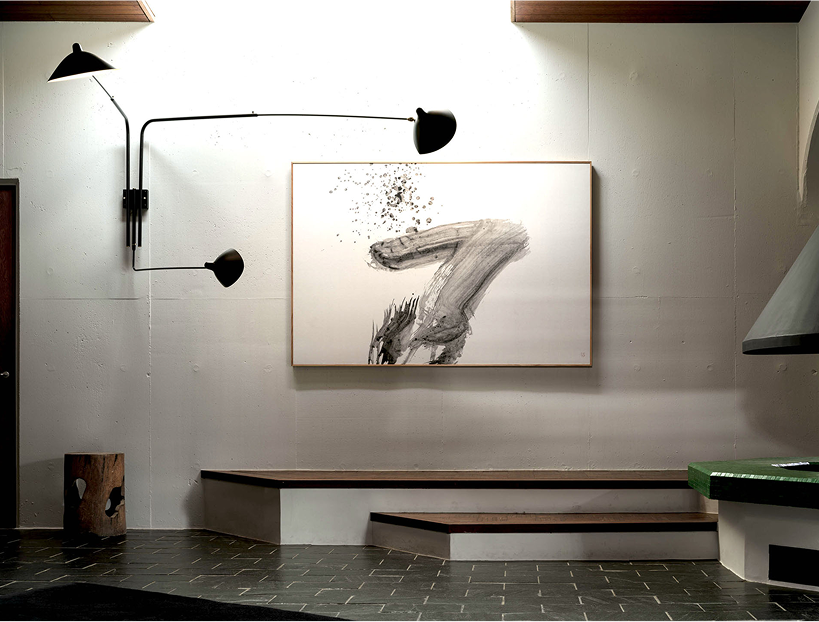
Yu-ichi Inoue
No
1969
©UNAC TOKYO
José Zanine Caldas
Denuncia Stool
1970s
Serge Mouille
Three Arm Rotating Wall Sconce
1954
Serge Mouille
1922-1988Serge Mouille was born in Paris, France, in 1922. A boy who spent hours sketching plants at the botanical garden, he entered the École Nationale Supérieure des Arts Décoratifs at the age of 13, the youngest student ever admitted. There, he studied metalwork and silversmithing under sculptor Gabriel René Lacroix and joined Lacroix’s studio after graduation. In 1945, Mouille began teaching at the same school and later opened his own studio.
In 1953, Mouille received a request to design lighting fixtures. Until then, he had worked on handrails, chandeliers, and wall sconces. The request came from Jacques Adnet, a leading French Art Deco designer. This led to two types of standing lamps—one with a single arm and one with three arms—and marked Mouille’s transition from craftsman to designer. It was the beginning of his iconic Formes Noires series.
His works, which resemble large, angular insects, feature sculptural forms inspired by the female body and functional adjustability that adds movement to space—traits that still maintain their originality today. In 1956, Galerie Steph Simon on Boulevard Saint-Germain in Paris began showcasing Mouille’s lighting alongside furniture by Jean Prouvé, Charlotte Perriand, and Isamu Noguchi. This period marked the peak of Mouille’s career. He also designed lighting for facilities such as the University of Antony, which involved Prouvé and Perriand.
In 1962, Mouille presented a completely different design: the Les Colonnes floor lamp series, based on fluorescent lights, which were still rare in French homes. These used geometric shapes such as circles, squares, and right angles, and were more artistic than functional. While they were not widely accepted at the time, they have since been reappraised, though they marked the end of his career as a designer. In 1954, Mouille had become head of the metal workshop at the École Nationale Supérieure des Arts Décoratifs. In 1963, due to illness and a desire to focus on teaching, he ceased producing lighting and dedicated the remainder of his life to education and research in metalwork. In contrast to Caldas, Mouille transitioned from organic forms to modernism. Presenting their opposing trajectories in the same space was one of the exhibition’s themes.
Mouille’s will, which rejected industrial mass production, lives on today in lighting still crafted by hand. His pieces, which carefully balance machine precision and handcraft, show a stunning interplay between light source and shade, with beautiful light diffusion and practical use. His lighting illuminates everything it touches with elegance.
Credits
BUNDLE ARTICLE No.002
Director: Masato Kawai
Photo: Sohei Oya
Editing and Text: Yoshinao Yamada
Design: Jacopo Drago
Cooperation:
EDITIONS SERGE MOUILLE JAPAN
INITIAL JAPAN
NAGISA MUSIC&ARTS
UNAC TOKYO
This booklet was published as the official record of “The Will of Creators Transcending Time – Yu-ichi Inoue, José Zanine Caldas, Serge Mouille –.”
Unauthorized copying, reproduction, or redistribution of articles, photographs, etc. is prohibited.
